NewsBeyond the Report Card
Understanding Every Child's Learning
A report card shows marks, not the whole story. Discover how schools, teachers and parents can better understand every child's learning progress.
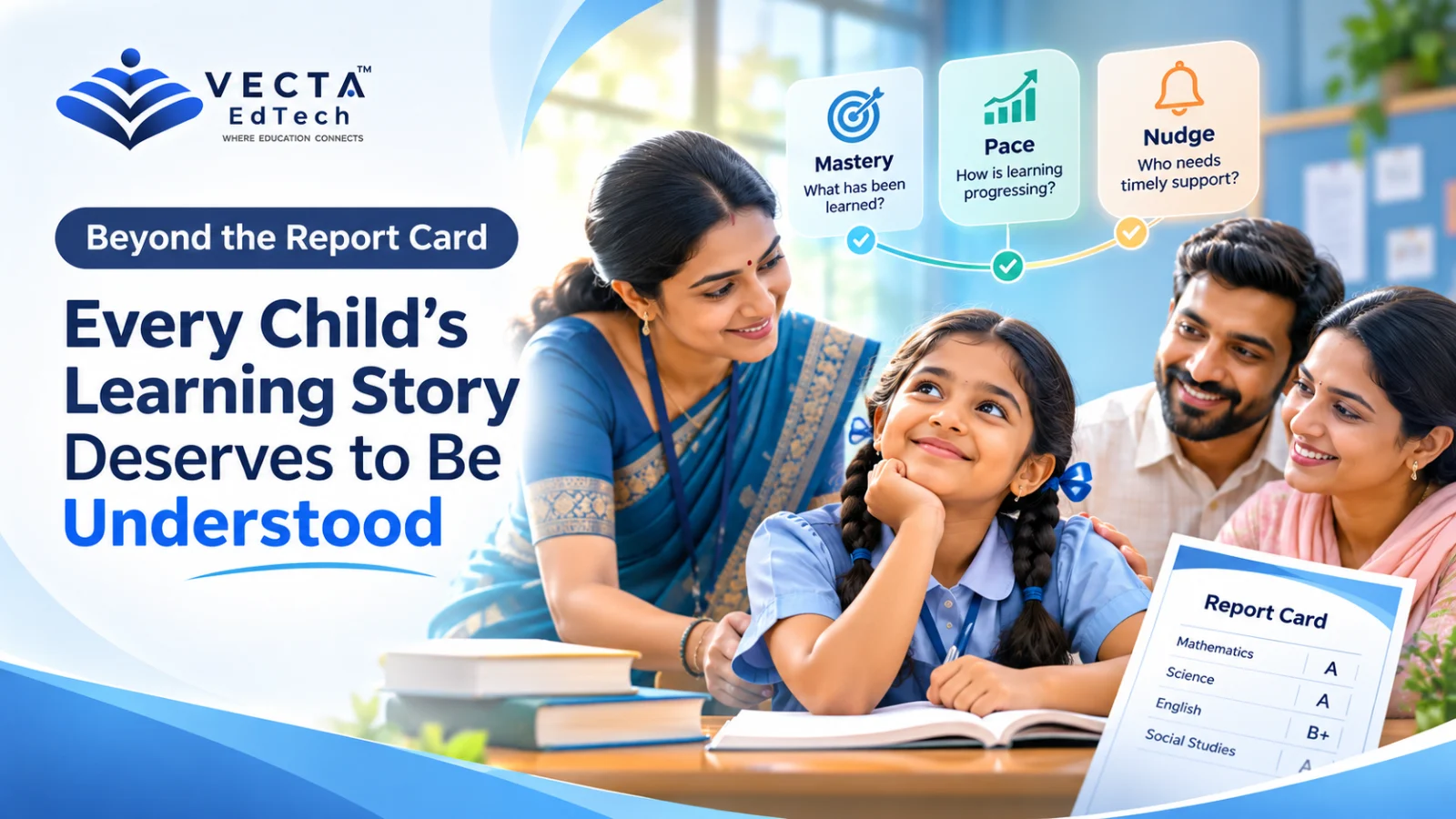
Beyond the Report Card: Understanding Every Child's Learning
A report card tells us what a child scored. The attendance register tells us how often the child came to school. Neither tells us the one thing parents and teachers really want to know: is the child understanding what is being taught?
Same mark, two different stories
Meet Riya and Arjun. They sit in the same Class 4 classroom, and in last week's maths test both of them scored 36 out of 50. On a report card, they look exactly the same.
But the test had three kinds of questions: fractions (halves and quarters), measuring length, and telling the time. Riya did well in measuring and telling the time but got most of the fraction questions wrong. Arjun was the opposite. Fractions were easy for him, but he lost most of his marks on telling the time.
Same mark. Two very different needs. And if nobody looks closer, Riya may carry her confusion about fractions into the next chapters that build on it, and the gap only shows up months later.
Teachers see it first
Teachers notice far more than marks show. But with a full class and a syllabus to finish, it is hard to keep track of every child, every concept, every week.
Technology should not replace a teacher's judgement. It should give teachers a clearer picture, so their time and attention go where they are needed most.
Parents want more than results
Parents often ask the same questions. Is my child understanding what is taught? Is the class on track? What should we work on at home? Most of the time, the answers arrive only when the exam results come home, and by then weeks have passed.
When parents and teachers see the same picture, they can work together while there is still time to help.
How Vecta helps
At Vecta EdTech, we are building one app that connects schools, teachers, parents and students around how each child is learning. Here is what it would show for Riya and Arjun.
Mastery: what each child has understood
Instead of just a 36 out of 50, Riya's parents can see where she is strong and where she needs a little more help. For Riya, that is fractions. For Arjun, it is telling the time. Their teacher gets the same clear view for the whole class.
Pace: whether the class is on track
Pace shows where the class is in the syllabus, week by week: what has been finished, what is being taught now and what comes next. Riya's teacher can see that fractions were finished last week and the coming chapters build on them. That makes Riya's gap important now, not at the end of the term.
Nudge: one small step at the right time
Nudge turns what Vecta sees into a simple next step. Riya's parents might get a suggestion like this: spend ten minutes tonight cutting a chapati into halves and quarters with her. Her teacher gets a nudge too, showing the few children in the class who need another look at fractions, so she can help them together in one short revision.
More than a mark
Riya and Arjun scored the same, but they needed different help. A report card could never show that. Every child has strengths to build on and gaps that can be closed with the right help at the right time.
When schools, teachers and parents can see how a child is really learning, that help can come early.
Want to see how this works in your school? Book a free demo:
https://vectaedtech.com/contact/
Read our previous article: